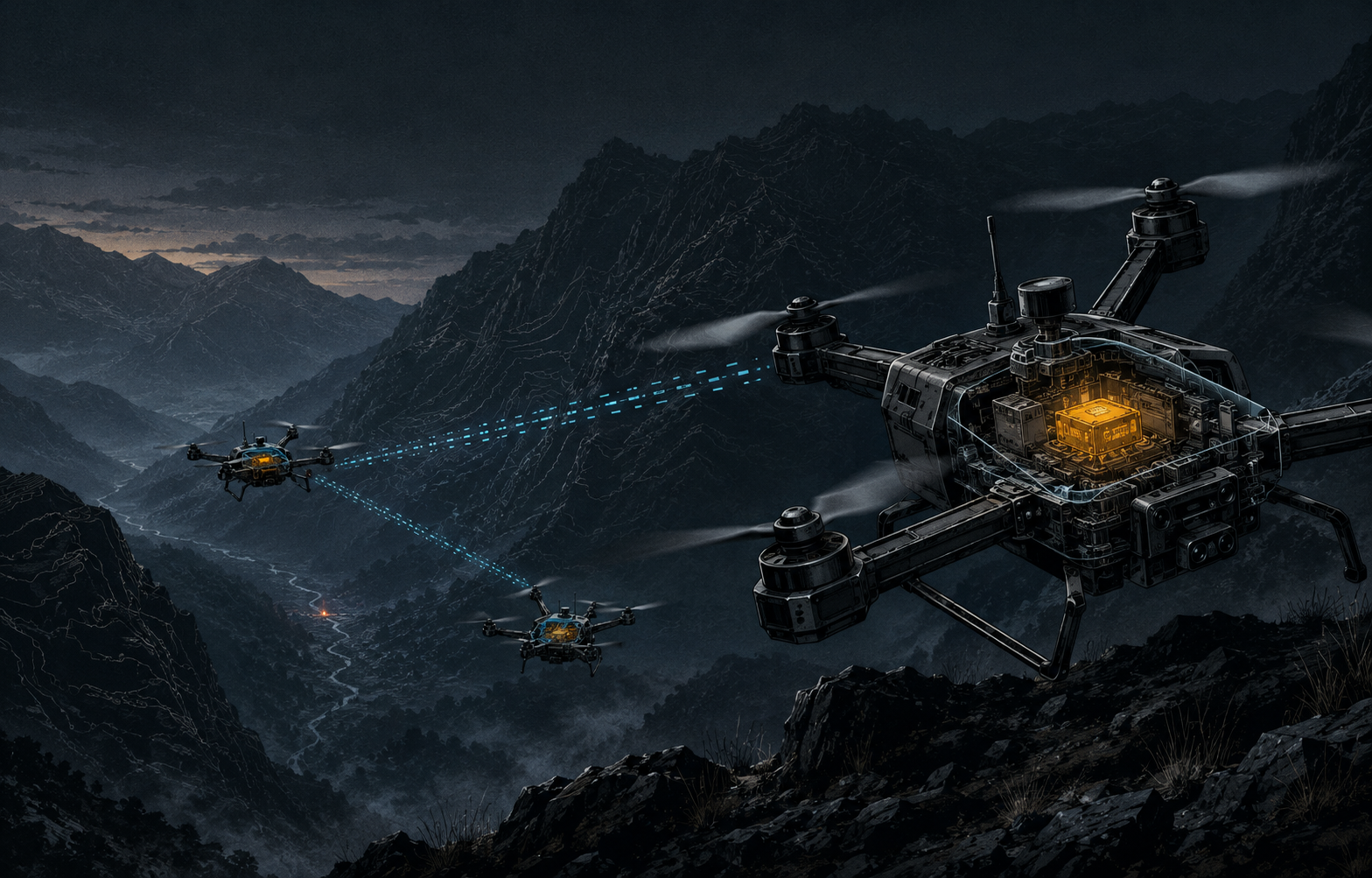
ruv drone plus LatentMeshflight safe coordination
Share drone state.
Keep flight control local.
LatentMesh helps ruv drone peers choose safer work by sharing signed position, battery, and link health over WiFi, BLE, or Meshtastic. Updates expire quickly and can never arm, steer, or change flight mode.
Better task choicesWorks on weak linksRejects bad data
Key difference: MAVLink can reach the autopilot. LatentMesh ends at a separate advisory store.
No commandsadvisory only
5 secdefault expiry
Offby default
What LatentMesh adds
Better decisions between drones. No new way to fly them.
Each drone gets a small, trustworthy picture of its peers. That is enough to choose better work, avoid unavailable teammates, and keep operating when the network is weak.
Stop offering new work to a peer that is low on battery, stale, unreachable, or in a failsafe.
Move compact updates across WiFi, BLE, or Meshtastic without flooding the radio.
Reject altered, replayed, oversized, or expired updates before they enter the advisory store.
If the mesh disappears, each vehicle keeps its existing local plan and safety logic.
Use LatentMesh forPeer status, task fitness, progress, availability, and advisory coordination.
Keep out of LatentMeshArming, modes, setpoints, payload control, geofences, and failsafes.
01
Why this exists
A swarm needs context, not remote control.
Imagine drone 7 is low on battery. Its peers should stop offering it new search sectors. They should not land it, change its mode, or steer around it.
That distinction is the architecture. LatentMesh carries advice about peers. Existing ruv drone safety logic remains the only authority over each vehicle.
“Peer 7 has 12 percent battery and should receive no new task.”
“Land peer 7, change its mode, or publish a flight setpoint.”
02
One message, end to end
One update passes seven checks before a peer can use it.
The receiver verifies identity, freshness, size, meaning, and policy before saving anything. A failed check changes nothing.
7source
1Local truth remains local
2Same meaning on every peer
3Identity plus integrity
4Small frames, fixed bounds
5Reject before commit
6Useful, temporary, nonbinding
7Remote facts cannot grant authority
advisory
Start with local state
ruv drone reads its own position, motion, battery, link quality, and safety status. The mesh receives a read only view. It does not receive a flight controller handle.
Local truth remains localMake every value deterministic
Floating point values become canonical Q16.16 fields with stable schema IDs. Every peer computes the same bytes and the same state hash.
Same meaning on every peerBind identity to meaning
Ed25519 signs the source, epoch, sequence, state hash, priority, and semantic body. A software key works today, while the signer seam accepts a keystore or HSM in production.
Identity plus integrityBreak one update into safe pieces
The envelope is fragmented for WiFi, BLE, or Meshtastic. Every fragment has strict size limits and CRC32C corruption detection.
Small frames, fixed boundsTrust nothing on arrival
The receiver reassembles per source, verifies the enrolled key, checks replay windows, sequence, epoch, schema, hashes, freshness, ranges, and residual policy.
Reject before commitStore a short lived advisory
Accepted peer state enters a separate advisory store. The default snapshot expires after five seconds and never enters the authoritative flight topology.
Useful, temporary, nonbindingLet local policy choose
A bad peer battery, link, or fail safe report can only reduce that peer's eligibility for new cooperative work. A locally approved mission manifest is still required.
Remote facts cannot grant authority03
The safety boundary
Advice may cross. Control may not.
LatentMesh can help a drone choose better work. It cannot arm, steer, change flight mode, override a failsafe, or grant mission authority.
LatentMesh advisory plane
Signed peer factsposition, motion, battery, link, safety report
Short lived storeseparate, bounded, expiring
Mission policylocal allowlist, reduce only eligibility
NO CONTROL PATH
ruv drone authority
Flight controllerarming, modes, setpoints, failsafes, geofence, payloads
No actuation No safety input No topology authority
04
Try to break it
Bad data stops at the door.
Try a clean, altered, replayed, or stale update. Nothing reaches the advisory store until every safety check passes.
LMS1
Receiver decisionAccepted as advisory
The signed state is fresh, complete, known, and within range. It expires automatically.
Replay state commits with the advisory05
Work with the link you have
Send the most useful facts first.
When a link gets worse, LatentMesh protects urgent health updates and drops low value chatter instead of flooding the radio.
CleanHostile
Selected wire profile
WiFi
- Frame budget
- 256 bytes
- Partial expiry
- 2 seconds
- Fresh advisory
- 5 seconds
- Scheduling
- 128 frames per second by default
Illustrative scheduler response
Protected delta
- Delivery
- Selective ACK
- Redundancy
- 1.25×
- Traffic
- Favor important updates
This control explains policy behavior. It is not an RF performance claim. Real radio validation remains a release gate.
06
Practical missions
Useful coordination, even when the link gets worse.
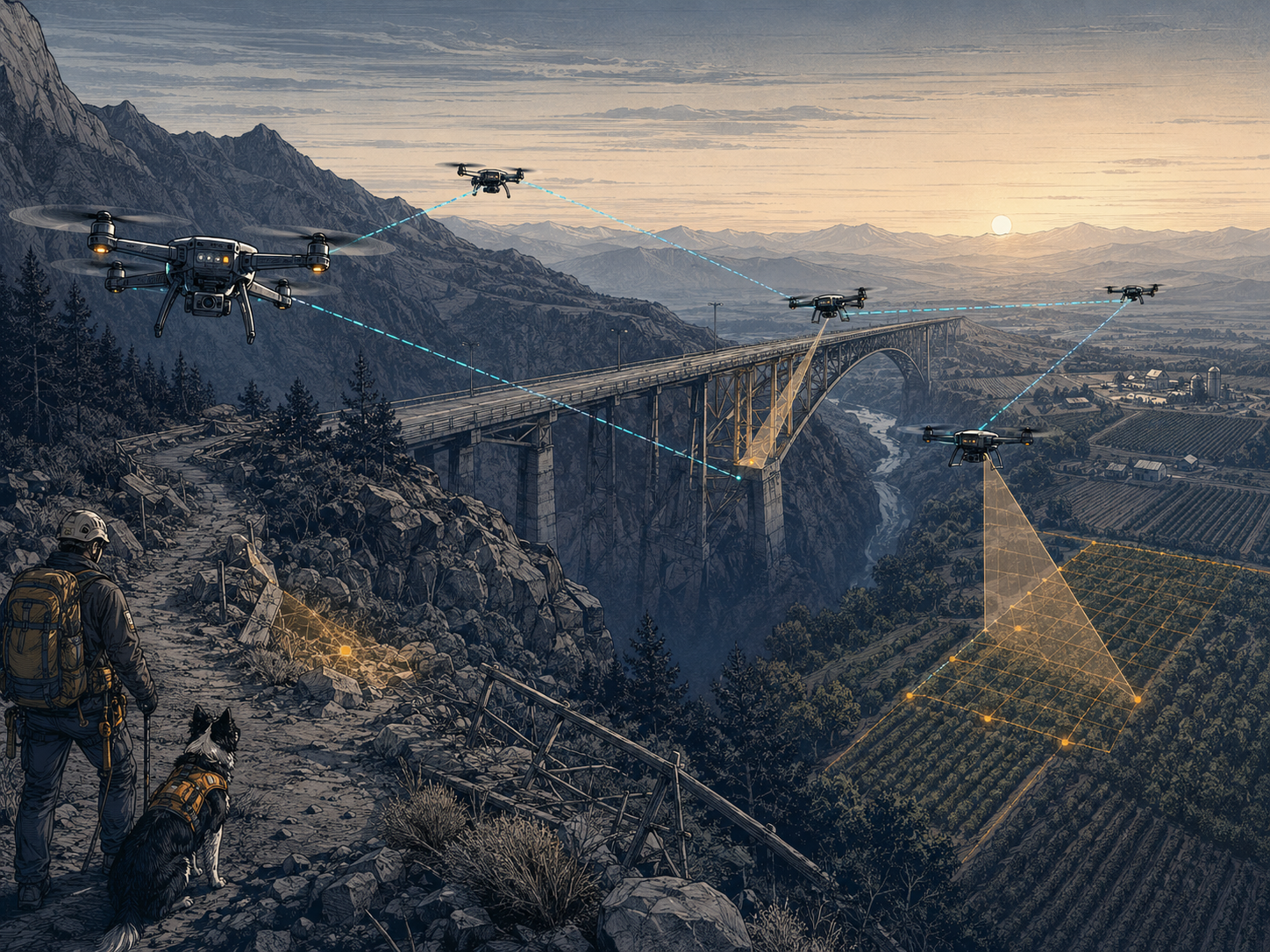
Search and rescue on broken links
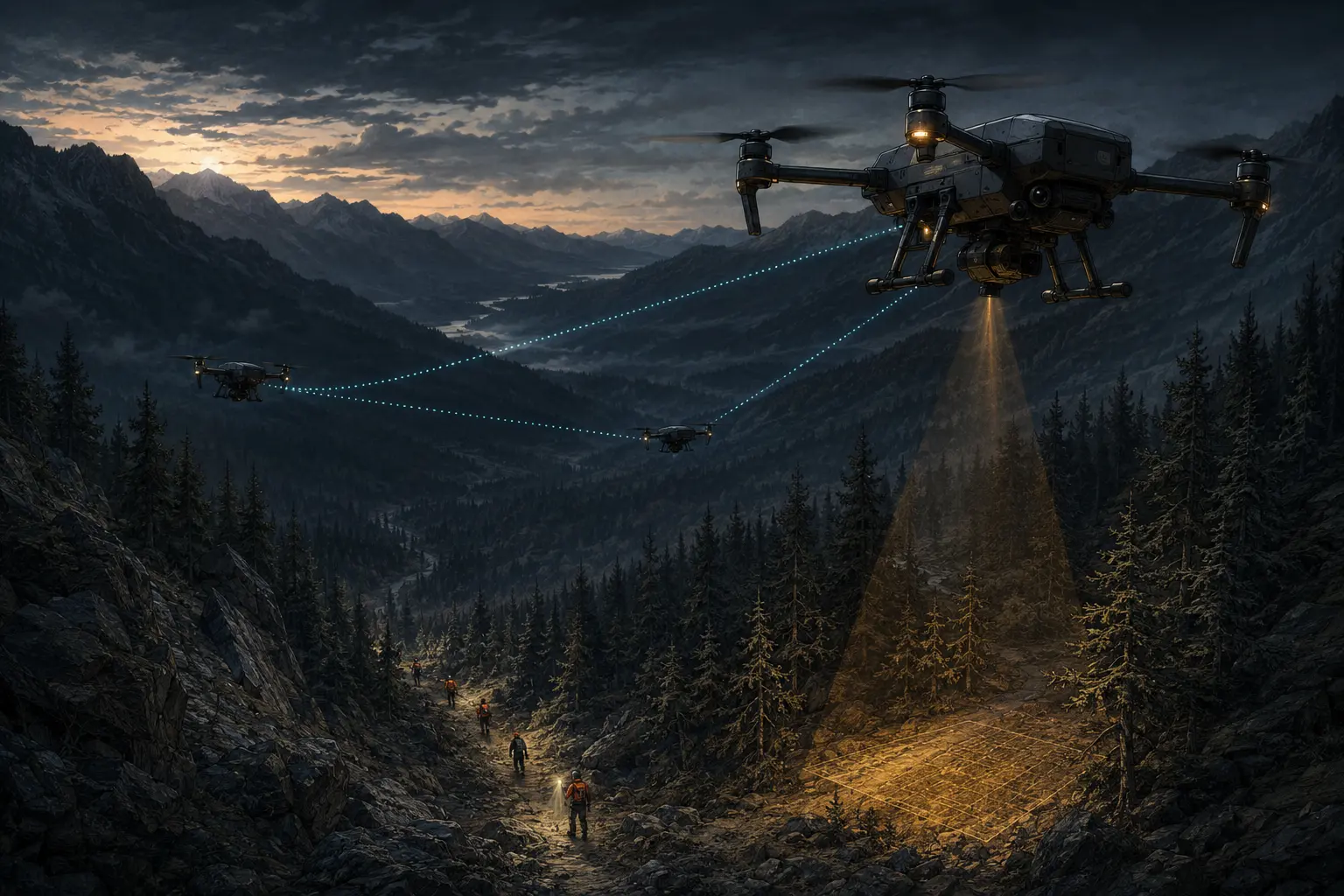
Peers share fresh position, link, battery, and availability. If a drone goes stale or reports a failsafe, the mission planner stops giving it new search sectors. The vehicle keeps flying its own safe local plan.
Useful factWho can cover the next sector?
07
Use the right layer
A missing layer, not a replacement stack.
LatentMesh adds signed drone state and safe advisory coordination. Existing flight control, robot middleware, and radio transports keep their jobs.
ArchitectureBest roleTrust and authorityFit
LatentMesh planeWiFi, BLE, Meshtastic
Signed peer status for choosing cooperative work
Rejects altered, replayed, stale, or oversized updatesAdvisory only. Local policy decides.
Best fit for sparse coordinationExisting serde gossipUsually general IP links
Simple messages on a general network
Needs signature, replay, schema, and fragmentation workAuthority depends on the consumer.
Easy start, missing safeguardsMAVLink extensionsFlight control transport
Autopilot telemetry and commands
Signing protects the link, but it remains near vehicle controlCan reach authoritative systems.
Keep at the autopilot boundaryDDS or ROS 2Higher bandwidth local networks
Rich local robot data
Powerful middleware with more runtime and network overheadThe application defines authority.
Strong locally, heavy for sparse radioMeshtastic aloneLow bandwidth long range radio
Radio transport and channel networking
Moves bytes securely but does not define drone state meaningNo mission policy by itself.
Useful transport below LatentMeshSimple rule: MAVLink controls the vehicle. DDS and ROS 2 move rich local data. Meshtastic moves bytes over long range radio. LatentMesh makes sparse peer status safe enough to use as advice.
08
What is implemented now
Fast in code. Radio proof is the next gate.
The optional Rust implementation passes all three feature test modes. The numbers below measure local processing, not real world radio performance.
494test runs passed across three matrices
Criterion range • 20 samples • Xeon Platinum 8573C
State projection386.62 to 397.98 nanoseconds
0.392 µsSign and fragment64 byte MTU
39.2 µsReassemble and admitverify, replay, policy
49.6 µsZero findingsdeep security, STRIDE, and secrets scans
No known vulnerabilitiesone preexisting unmaintained transitive warning
292 logical bytes404 wire bytes in the loopback keyframe
09
Latest ruv drone capabilities
Everything needed for a narrow, safe advisory plane.
Cargo feature is off by defaultExact upstream revision pinCanonical Q16.16 stateEd25519 semantic envelopesSoftware key or HSM signer seamPer source bounded reassemblyReplay checkpoints across restartFull keyframe every 16 messagesAdaptive utility per byte schedulingDefault deny capability gateLocal mission manifest approvalPayload free saturating metricsBounded loopback and UDP transportNaN geometry now fails closed
Also fixed during review
Unknown or nonfinite peer geometry now fails closed.
A NaN distance could previously collapse to “infinitely far.” It now reaches the existing EmergencyDiverge safety path as unknown geometry.
10
Deploy without crossing the line
Start as an observer. Expand only after evidence.
Each rollout step adds one small capability. Turning off the local task removes the feature immediately without waiting for the network.
- 01Disabled
Feature not compiled or no session starts. Existing ruv drone behavior is the baseline.
- 02Loopback
Golden vectors, malformed frames, replay, fragmentation, and policy tests only.
- 03Shadow receive
Decode real bytes and collect payload free counters. No advisory reaches orchestration.
- 04Canary advisory
One ground node and at most two vehicles. UI and reduce only availability, with no task proposals.
- 05Fleet advisory
Locally approved manifests may use permitted fields after the canary error budget passes.
Remaining release gateTwo node hardware in the loop and real RF validation
Measure latency percentiles, allocation, loss, reorder, restart recovery, clock drift, protected keys, rotation, disable path, and regional RF compliance.